IIS Fleet
How do Fleets with UEE work and compared to IIS.
Anything marked with Underline is set to be links. Just surround your word using: <u> and </u>
Still trying to figure out how to update the php.ini and over-ride the limit based on images being set at 7MB.
Contents
- 1 UEE Ranks
- 2 Crew Departments & Departmental Patches
- 3 UEE Fleet Organisation
- 4 IIS Fleet Organisation
- 5 Ship Types
- 6 X3
- 7 A
- 8 Notes
UEE Ranks
Breakdown from Articles (Political down to newest recruit)
Here is the flow of command as well as the structure/naming conventions for each level of the Navy.
Command Hierarchy
Imperator
Head of the UEE.
The highest ranking member of the Navy and represents the branch in the government. He or she dictates policy more than operational control.
Grand Admiral
A chairman and the joint chiefs all rolled into a single person, but with overall operational authority as well.
Major Fleets
Named after Earth’s constellations, each fleet is commanded by an Admiral, who reports to the Grand Admiral.
Regional Fleet Commander
Vice Admiral who oversees Fleet activity in specific regions of the Major Fleet’s Area of Operation. Named after universe landmarks (i.e. Gamma Region, Earth Fleet).
Specialty Groups
Reports to Fleet Admiral; this is where the Group Commander (Vice Admiral) of all squadrons of Fighters would reside, controlling the training pipeline, overseeing maintenance requirements in both materials and credits, and assigning nugget pilots to squadrons.
Here are the acronyms for the types of groups;
- IF: Intercept Fighter: Hornet
- IB: Intercept Bomber: Ship Type
- SB: Strategic Bomber: Retaliator
- EW: Electronic Warfare: Ship Type
- SR: Search and Rescue: Ship Type
- PR: Patrol/Reconnaissance: Ship Type
Battle Group
Usually consists of 1 Main Carrier, 2-4 Escorts and a varying number of large Combat/Support Vessels. Use numbers for designation (312th Battle Group). These are commanded by a Rear Admiral who reports to Regional Fleet Commander.
Capital ships designations;
- CV: Fleet Carrier: Bengal
- CVE: Escort Carrier: Ship Type
- BB: Battleship: Ship Type
- CA: Cruiser: Ship Type
- CB: Battlecruiser: Ship Type
- DD: Destroyer: Javelin
- FF: Frigate: Idris
- FFL: Frigate Light: Ship Type
- K: Corvette: Ship Type
- AP: Transport: Ship Type
- AOG: Tanker: Starfarer
Note: Look at old battle groups from WWII and determine flow/structure of Battle Formation Hierarchies. ie. How many bombers make up a group, and so on.
Wings
NEED to define details...
Squadrons
Squadrons are under the command of the Carrier Wing Commander who is stationed on the largest carrier in the Battle Group and reports to the Rear Admiral. The Carrier Wing assigned to the battle group shares the number assigned to the carrier which originates from the first ship in the class (randomly determined), and then subsequent ships are numbered sequentially.
Squadrons are numbered in the order in which they were founded and consist of up to four flights.
Flights
Typically, each of these flights have six ships, but this number can fluctuate based on availability/need.
The naming of flights is covered in the recap below but here’s a pic to illustrate the entire system. For ease’s sake, I used the first flight naming mechanic suggested above.
[[File:FinalSquadronBreakdown.jpg|link= ]]
Recap
For the past few weeks, we have been playing around with Squadron Numbering. That topic has expanded into an exploration into how the Navy itself is organized and the numbering systems involved.
There was a lot of discussion regarding the naming of the flights within the squadron, specifically using the callsign of the ranking officer to identify the flight. I’m starting to agree that it might be very confusing to understand who is who, particularly when flights from multiple ships are in the same battle. While the callsign might be a unique identifier, a pilot can glean no additional information from it.
There was a suggestion to go back to a color-coding system, which would be awesome just to be able to say "Red-Five standing by," but it feels like you would run out of colors very quickly if that was your only indicator.
Therefore, I suggest two options:
1. Similar to Homewreaker’s suggestion, the flight is known as: Squadron #-Phonetic Alphabet-Ship #. So the fourth ship in 82nd Squadron Charlie Flight would be "Charlie-Four" if they’re on a mission with just their squadron and 82-Charlie-Four if it’s a big multi-squadron brawl.
2. Basically the same system but with colors instead of the Phonetic Alphabet, so instead of "Charlie-Four" it would be "Gold-Four" or "82-Gold-Four."
Ranks for the CO of Smaller Capital Ships
There were a lot of questions regarding the notion that Commanders and Lieutenant Commanders would be in charge of smaller capital ships, instead of Captains. Buttface addressed this concern with a good explanation and Dzur weighed in as well:
The idea here is you don’t want to wait until someone is a Captain (rank) to find out if he or she has the ability and gumption to be “the man”, even if the command is quite small. Thus, officers who display a promising early career are offered command early, both to get the best people into the jobs, but also as an opportunity to succeed or fail on the small scale (crew of 25) before doing so when it could affect the lives of 5000 crewmen on a carrier. Other officers who break out as leaders later in their career can still be eligible for command at the Commander rank.
Ranks for the CO of Smaller Capital Ships
Officers of various ranks (examples from Dzur’s email: a Carrier skipper would be a Captain, while a Destroyer, Cruiser, or Battleship skipper would be a Commander, a frigate or support vessel skipper may be a Lieutenant-Commander) who report to Rear Admiral.
- CAW assigned to the battlegroup shares the number assigned to the carrier. This initial number for the first ship in the class is randomly determined and then subsequent ships are numbered sequentially.
- NOTE: CAW Needs clarification.
- Rear Admiral ~ ADD Table with Ranks per Ship Size
- Carrier: Captain
- Destroyer: Commander
- Cruiser: Commander
- Battleship: Commander
- Frigate, Support Vessel: Lieutenant-Commander
Logistics
Quintero and Infidel both brought up excellent points about the inclusion of Logistics and where they fit in this hierarchy. I liked Infidel’s placement as a separate branch that reports to the Grand Admiral. Combining suggestions from Quintero, Infidel and Dzur, it could include such specialties as:
- Logistics/Transport
- Salvage
- Exploration
- Research/Development
- Personnel & Records
- Intelligence
Perhaps the divisions that require ships (Transport/Supply, Salvage, Exploration) could belong to Special Services Fleet.
Diagram with Templates
Need to make a series of templates for creating an SVG pic table and/or Family Tree styled Diagram Tree here.
See examples;
- English monarchs family tree ~ Uses Templating
- Family Tree Main Page
Sources
- Numbering System for Fleets/Squadrons/Etc. ~ Lore Builder #9
- Squadron Numbering System ~ Lore Builder #10
- Squadron Numbering System ~ Lore Builder #11
- Squadron Numbering ~ Lore Builder #12
- UEE Navy Numbering & Organization ~ Lore Builder #13
Crew Departments & Departmental Patches
Insert Article information here
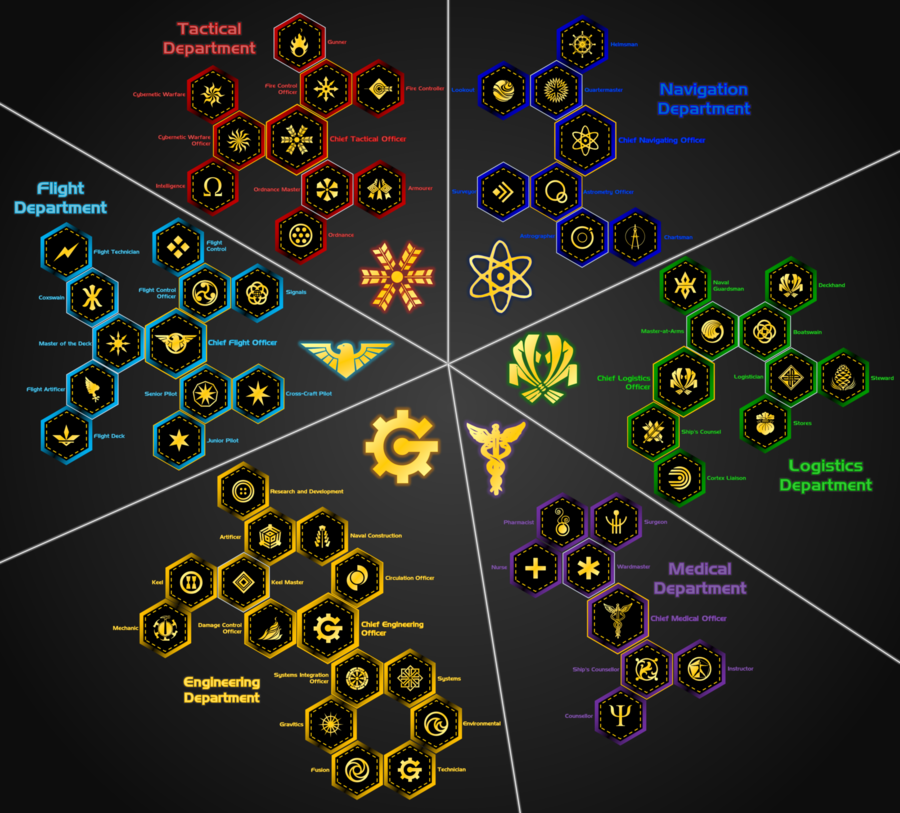
- UEN Crew Department Patches (Full) by Leovinas
This is a hierarchical chart showing every department specialisation patch aboard a typical ship in the United Earth Navy. The hexagonal patches are worn on the left shoulder of the uniform. Patches with a gold rim are worn exclusively by officers; those with a silver rim are worn exclusively by non-commissioned officers. In each department, the farther away a patch is from the chief department officer, the more junior the crew members it is generally worn by.
As with the previous chart, each department does more or less what it would be expected to: Tactical fights the ship, Navigation steers it, Flight operates the small craft and signals, Engineering maintains the ship, Medical maintains the crew, and Logistics keeps everything organised, supplied and moving.
Departments
Tactical
- Chief Tactical Officer
- Ordnance Master
- Armourer
- Ordnance
- Cybernetic Warfare Officer
- Intelligence
- Cybernetic Warfare
- Fire Control Officer
- Gunner
- Fire Controller
- Ordnance Master
- Chief Navigating Officer
- Quartermaster
- Lookout
- Helmsman
- Astronomy Officer
- Surveyor
- Astrographer
- Chartsman
- Quartermaster
Logistics
- Chief Logistics Officer
- Ship's Counsel
- Cortex Liaison
- Master-at-Arms
- Naval Guardsman
- Boatswain
- Deckhand
- Logistician
- Steward
- Stores
- Ship's Counsel
Medical
- Chief Medical Officer
- Ship's Counselor
- Instructor
- Counselor
- Wardmaster
- Nurse
- Pharmacist
- Surgeon
- Ship's Counselor
Engineering
- Chief Engineering Officer
- Systems Integration Officer
- Systems
- Environmental
- Technician
- Fusion
- Gravitics
- Damage Control Officer
- Keel Master
- Keel
- Mechanic
- Artificer
- Research and Development
- Naval Construction
- Circulation Officer
- Systems Integration Officer
Flight
- Chief Flight Officer
- Senior Pilot
- Junior Pilot
- Cross-Craft Pilot
- Flight Control Officer
- Signals
- Flight Control
- Master of the Deck
- Flight Artificer
- Flight Deck
- Coxswain
- Flight Technician
- Senior Pilot
Notes: Same can be done with Fleets, flights, squadrons, and roles, etc. This also needs to be broken further into ranks for the crew members.
UEE Fleet Organisation
Insert Article information here
- A
- A
- A
IIS Fleet Organisation
IIS Fleet Organisation Research
Organisation Research links and formulation of a complex organisation hierarchy.
- A
- A
- A
Ship Types
WWII
- Capital Ships and Nuernbergs:

- Light Cruisers and Destroyers - including completed Mob with twin 5.9" gun turret

Hull Classification Symbol
Warships
Warships are designed to participate in combat operations.
Based from Hull classification symbol: US Navy
The origin of the 2 letter code derives from the need to distinguish various cruiser subtypes.
| Cruiser | Armored | CA |
|---|---|---|
| large | CB | |
| battle | CC | |
| Light | CL | |
| aviation or Voler | CV | |
| Destroyer | ship | DD |
| Escort | DE |
Types
- Warships
- Aircraft carrier type
- Surface combatant type
- Submarine type
- Patrol combatant type
- Amphibious warfare type
- Combat Logistics Type
- Mine warfare type
- Coastal defense type
- Mobile logistics type
- Auxiliary type
- Airships
- Support ships
- Support type
- Service type craft
- United States Coast Guard craft
- Temporary designations
List all Types from page and highlight variants.
Ship List
- See Also: Ships
Capital
- A
- A
Escort
- A
- A
Fighter
- A
- A
Other
- A
- A
X3
A 'TLA' is a Three Letter Acronym. Not all the acronyms used have three letters, of course!
Ship Classes
Ships are divided into classes according to their purpose. Most races have at least one type of ship in each class.
| Icon | Ship Class | Description |
|---|---|---|
| 900px | M0 | Planet-killer |
| 900px | M1 | Carrier |
| 900px | M2 | Destroyer |
| 900px | M2+ | Heavy Destroyer |
| 900px | M3 | Heavy fighter |
| 900px | M3+ | Heavy fighter (Improved) |
| 900px | M4 | Medium fighter |
| 900px | M4+ | Medium fighter (Improved) |
| 900px | M5 | Scout |
| 900px | M6 | Corvette |
| 900px | M7 | Frigate |
| 900px | M7M | Missile Frigate |
| 900px | M8 | Bomber |
| 900px | TS | Transport Small |
| 900px | TL | Transport Large (can transport station kits) |
| 900px | TP | Transport Personnel/Passenger |
| 900px | TM | Transport Military (a small carrier ship) |
| 900px | OWP | Orbital Weapons Platform |
| 900px | LT | Laser Tower |
| 900px | NavSat | Navigation Relay Satellite |
| 900px | AdvSat | Advanced Satellite |
Ship Class Groupings
Ship classes are often grouped together to simplify description. The type of ships being used play the largest role in combat strategy, as fights between different classes of ships can become severely lopsided in straight contests of power.
Combat ships are generally categorized into 2 different groups:
- Capital Ships
- Fighters
A term coined here to describe combat ships not fitting the accepted groupings' descriptions is:
- Escort
Ships designed primarily to carry cargo can be described as:
- Transports
Ships who carry other ships can be described as:
- Carriers
| Capital | Escort | Fighter | Other | |
|---|---|---|---|---|
| Combat |
M1 M2, M2+ M7, M7M, M7C |
M6, M6+ M8
|
M3, M3+ M4, M4+ M5 |
M0 |
| Transports |
TL |
TM |
TS, TS+ TP |
AP Ship Classes
These are listed Largest at top to smallest at bottom of list
| Ship Class | Ship Type | Description |
|---|---|---|
| M1 | Large Carriers | The M1 class is the largest ship type, able to carry smaller ships such as M3/4/5. The M1 may not have the largest weapon systems, but with a hanger of 30+ ships it can deliver some serious damage. The fighters act as drones. Often the M1 itself is setup for anti-fighter. |
| M2 | Large Destroyers | These ships have the largest weapon systems in the game, featuring around 40-60 powerful weapons. Destroyers also have very strong shields and are capable of taking on other Destroyers or fighters. However M2 don't often have a hanger of any sort and are very slow. |
| M7M | Missile Frigates | The M7M class is like the M7, as in shield and cargo size but rather than use normal guns, the M7M launches high powered missiles. These missiles can do very large amounts of damage to capital ships and fighters. The M7M class also have access to a special missile called the boarding pod. These missiles allow M7M's to send a group of 4 marines in a missile like craft. The downside to the M7M class is that when the ship runs out of missiles, then the ship is easy pickings. |
| M7 | Frigates | The M7 range is a half-way house between the M6 and the M2 class. They are roughly half the size of a M2. They have a good amount of shielding and weapons. They can sometimes even take on a * M2! M7's are usually much faster than M2's, so can be more fun to pilot. |
| M7C | Small Carriers | The M7C range is a newly introduced class, called the small carrier. The M7C is a mix of M1 and M7 technology, allowing fighters to dock inside the M7C hanger. |
| M6 | Corvettes | The M6 class is a medium sized ship that fits between M3 and M7's. They have a few turrets with and some 200MJ shields. M6's normally do well against fighter ships because of the arrangement of weapons they carry. For many pilots getting your first M6 is a milestone, as they are very useful ships. |
| M8 | Bombers | You may be forgiven if you think an M8 looks similar to that of a M3. That's because M8's are basically M3's but with one difference. The main weapon system has been replaced with a missile launcher. These missile launchers fire one type of missile and can deliver some serious damage to other ships. However when the ship runs out of missiles, then it becomes another easy target. |
| M3+ | Heavy Fighters+ | The M3+ range are upgraded M3's that feature usually an turret or two. In-game they class as M3, so you can dock them anywhere an M3 can dock on, such as a M7 or M1. M3+ offer a good half way between M3 and M6. |
| M3 | Heavy Fighters | There are 3 main types of fighter, the M3 being the largest. M3's have usually a few 25MJ shields and a good arrangement of frontal weapons. They can deliver some serious damage in large groups, even to large destroyers. |
| M4+ | Interceptors+ | The M4+ range are basically upgraded M4, with usually better shields (similar to that of a M3). They have a good top-speed making them great for gorilla style fighting. |
| M4 | Interceptors | The M4 is the medium sized fighter, that is a balance between speed and damage. However because of this balance they dont specialise in either, making a bit of a mixed choice for most. They often get over-looked by most pilots. |
| M5 | Scouts | The smallest of all the fighters - the M5. The M5 has one of the highest top-speeds making it great for exploring. However because its very light and fast design, the M5 only features very minimum shielding. In large groups they can be a pain for a M3 type craft, because they can be hard to shot-down. However a single M5 will struggle to take down anything bigger than a M4. |
- Star Citizen could use a similar system for the Ship Types, and other parts. With the complete list of US Navy, German Navy Ship Types.
| Ship Class | Ship Type | Description |
|---|---|---|
| TL | Station Carriers | The TL is the largest non-combat style ship with one feature not found on any other ship: ST sized cargo-bay. This ST sized cargo-bay allows a TL to pick-up and deploy stations in the x-universe. You can hire TL's but usually many pilots have they own TL. The reason for having your own is that you can fit a jumpdrive onto it, making much quicker to transport stations around. TL's do have a few weapons, however they are mainly just for defense. |
| TM | Ship Carriers | TM's are a relativity new ship class in the x-games (only added in X3TC). They are basically mini ship carriers, that can carry around 3 or 4 ships M3 or smaller craft. This makes them great at transporting captured ships to a distance shipyard, because the carrier itself can have a jump-drive - transporting itself and all the docked ships to another sector. ie. out of danger. |
| TS | Trade Ships | TS ships form the backbone of the economy, transporting wares all over the x-universe. You can think of TS ship being trucks that go down the motorways/roads. TS ships usually carry a few 25MJ shields but only for defensive reasons. |
| TP | Personnel Transporters | The last class of ship, the TP are basically TS ships which have an area for transporting passengers, like a bus. They can carry some cargo however they main role is transporting passengers or even marines. |
Note: Ideas: Star Citizen Spacecraft Classifications, RSI:Ship Development Document, Blog: Freelancer MOD, Kicking off SC
Flight Wing Colours
| Capital | Escort | Fighter | Other | |
|---|---|---|---|---|
| Combat |
Blue Gold Green Orange |
Purple Red Silver White |
Colour Colour Colour Colour |
Colour Colour Colour Colour |
| Transports |
Colour Colour Colour Colour |
Colour Colour Colour Colour |
Colour Colour Colour Colour |
Colour Colour Colour Colour |
Carrier Strike Group
In modern United States Navy carrier air operations, Carrier strike group (CSG) has replaced the traditional term of carrier battle group (CVBG or CARBATGRU). The Navy maintains 11 carrier strike groups, 9 of which are based in the United States and one that is forward deployed in Japan. CSG or CVBG normally consist of;
- 1 Aircraft Carrier
- 1 Guided Missile Cruisers (for Air Defense)
- 2 LAMPS (Light Airborne Multi-Purpose System) Capable Warships (focusing on Anti-Submarine and Surface Warfare), and
- 1–2 Anti Submarine Destroyers or Frigates.
The large number of CSGs used by the United States reflects, in part, a division of roles and missions allotted during the Cold War, in which the United States assumed primary responsibility for blue water operations and for safeguarding supply lines between the United States and Europe, while the NATO allies assumed responsibility for brown and green water operations.
Expeditionary Strike Group
An Expeditionary Strike Group is composed of;
- 1 Amphibious Assault Ship (LHA/LHD)
- 1 Dock Landing Ship (LSD)
- 1 Amphibious Transport Dock (LPD)
- 1 Marine Expeditionary Unit (MEU), AV-8B Harrier II aircraft, CH-53E Super Stallion helicopters and CH-46E Sea Knight helicopters or, more recently, MV-22B tiltrotors.
Cruisers, destroyers and attack submarines are deployed with either an Expeditionary Strike Group or a Carrier Strike Group.
Battleship Battle Group
During the period when the American navy recommissioned all four of its Iowa-class battleships, it sometimes used a similar formation centered on a battleship, referred to as a battleship battle group (BBBG). It was alternately referred to as a Surface Action Group (SAG).
The Battleship battle group, typically consisted of;
- 1 modernized battleship
- 1 Ticonderoga-class cruiser
- 1 Kidd-class destroyer or Arleigh Burke-class destroyer
- 1 Spruance-class destroyer
- 3 Oliver Hazard Perry-class frigates
- 1 support ship, such as a fleet oiler.
| Capital | Escort | Fighter | Other | |
|---|---|---|---|---|
| Combat |
Blue Gold Green Orange |
Purple Red Silver White |
Colour Colour Colour Colour |
Colour Colour Colour Colour |
| Transports |
Colour Colour Colour Colour |
Colour Colour Colour Colour |
Colour Colour Colour Colour |
Colour Colour Colour Colour |
A
- A
- A
- A
Notes
- A
- A
- A


